Anúncios
If your work history is short or empty, the resume problem is not that you have nothing to say. It is that the usual template asks for job titles and dates you do not have, so the page ends up looking thin. The fix is to change what fills the page: school projects, volunteer work, part-time and gig jobs, caregiving, certifications and skills you can prove.
This guide is for students, recent graduates, people changing careers and anyone returning to work after a long break. You will get a one-page structure that works for entry-level jobs, what to write in place of experience, how applicant tracking systems read your file, before-and-after bullet examples, and free tools to build the document.
No resume gets you a job by itself. A good one gets you to the interview more often, and with little experience that is the whole goal.
The one-page structure that works for entry-level jobs
Keep it to one page. Recruiters skim, and with limited experience a second page only shows them more empty space. Use this order, top to bottom:
- Name and contact line: city and state, phone, a professional email, and a LinkedIn URL if your profile is filled in. No street address, photo, birth date or marital status; US employers do not want them.
- A two- or three-line summary aimed at the job you want.
- Skills, grouped (for example, “Tools: Excel, Google Sheets, Canva” and “Languages: Spanish, conversational”).
- Experience, which for you means any of the categories in the next section, labeled honestly.
- Education and certifications.
If you are still in school or graduated in the last year or two, move Education up above Experience and include relevant courses, GPA if it is 3.5 or higher, and honors. Once you have a year of real work, Education moves to the bottom and shrinks to one or two lines.
About formats: you will see advice to use a “functional” resume, which lists skills instead of a timeline. Many recruiters distrust it because it looks like it hides something, and applicant tracking systems parse it poorly. A hybrid works better: a short skills section on top, then a normal reverse-chronological list of whatever experience you have, even if it is unpaid.
What to put instead of work experience
“Experience” on a resume does not have to mean a paid, full-time job. Recruiters for entry-level roles want evidence that you show up, finish things and work with people. All of these count, as long as you describe them truthfully:
School and personal projects
A group project with a deadline, a research paper, a website you built, a club event you organized. Write them like jobs: name of the project, your role, dates, and two bullets about what you did and what came out of it. A section titled “Projects” is normal and recruiters read it.
Volunteer work
Food bank shifts, church events, youth coaching, animal shelters. Volunteer roles often involve cash handling, scheduling, customer contact and training other people, which are the same tasks in many entry-level jobs. List the organization, your role and dates.
Part-time, seasonal and gig work
Babysitting, lawn care, delivery apps, tutoring, retail during the holidays. People leave these off because they feel too small. They show reliability and customer service. If you did several small gigs, group them: “Independent tutoring, 2024 to present, 6 regular students.”
Caregiving and career gaps
If you spent years caring for children or a family member, you can list it as a single line with dates, such as “Family caregiver, 2019 to 2025.” It explains the gap without apology. If you managed a household budget, medical appointments or a family business on the side, one bullet about that is fair game.
Certifications and short courses
A food handler card, CPR certification, a forklift license, a Google or Microsoft certificate, an online course with a final project. These are concrete and easy to verify. Put the issuer and the year.
How applicant tracking systems read your resume
Most medium and large employers in the US run applications through an applicant tracking system (ATS) such as Workday, Greenhouse or iCIMS. The system turns your file into text, fills in fields like name, employer and dates, and lets recruiters search and filter. It usually does not “reject” you on its own the way online myths claim, but if it cannot read your file, a recruiter searching for “Excel” will not find you.
What keeps your resume readable:
- One column. Two-column designs often get read across the columns, mixing your skills into your job descriptions.
- Standard headings: Summary, Skills, Experience, Projects, Education.
- No text inside images, text boxes, icons or charts. Skill “bars” mean nothing to a parser.
- Contact details in the body, not in the page header, which some systems skip.
- A .docx or a text-based PDF, whichever the posting asks for. If you can select the words in your PDF with the cursor, it is text-based.
Keywords matter because recruiters search with them. Read the posting, note the skills and tools it repeats, and use the same words where they are true for you. If the posting says “customer service” and your resume says “helped clients,” change it. Do not paste the job description in white text; recruiters see it in the parsed version and it looks dishonest.
Rewriting weak bullets: before and after
The most common problem with a first resume is bullets that list duties instead of results. A useful formula is action verb, what you did, and a number or outcome. You do not need big numbers; small, specific ones are more believable.
| Before | After |
|---|---|
| Responsible for the register | Handled cash and card payments for about 150 customers per shift with no drawer shortages over 6 months |
| Helped at the food bank | Sorted and packed donations for 200+ families a week; trained 4 new volunteers on the intake process |
| Did a group project on marketing | Led a 4-person team that built a social media plan for a local bakery; the owner used 3 of our post ideas |
| Babysat for neighbors | Cared for 3 children ages 4 to 10, two afternoons a week for 2 years, including homework help and school pickups |
| Good with computers | Built a shared Google Sheets tracker for a 30-member club’s dues and event sign-ups |
If you do not know an exact number, estimate honestly and say “about.” Never invent figures, titles or employers. Background checks and reference calls are routine even for entry-level jobs, and a made-up detail is the fastest way to lose an offer.
For the summary at the top, skip “hardworking team player seeking opportunities.” Write who you are, what you can do and what you want: “Recent community college graduate with 2 years of part-time retail and bilingual customer service experience, looking for a front-desk role in a medical office.”
Free tools to build and check your resume
You do not need a paid resume builder. Several of them advertise free creation and then charge to download the file, which you only find out after an hour of typing. These options are free:
Google Docs or Microsoft Word templates
In Google Docs, go to File > New > From template gallery and look under Resumes. Word has resume templates under File > New. Pick the simplest single-column option and delete any decorative tables. Both export to PDF and .docx.
CareerOneStop
CareerOneStop is sponsored by the US Department of Labor and has a free resume guide with sample resumes, plus a skills matcher that helps you name what you already do. It is plain, but the advice is solid and there is nothing to buy.
AI assistants, used carefully
ChatGPT or Gemini are good at turning “I did the register” into a sharper bullet and at comparing your resume to a posting to find missing keywords. They are bad at honesty: they will happily add numbers and achievements you never mentioned. Read every line and delete what is not true. Our guide to AI apps for study and work covers which assistant does what, and the privacy settings to change before you paste personal details in.
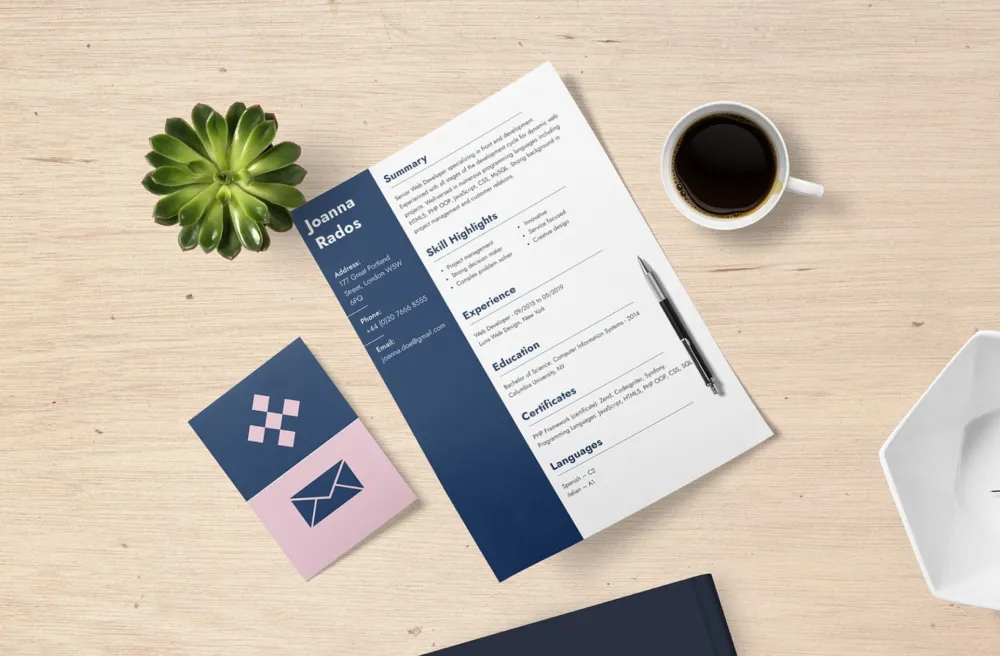
Canva has attractive resume designs, but many are multi-column and built from text boxes, which applicant tracking systems read badly. Keep the Canva version for handing out at a job fair and send the plain version online.
Mistakes that cost interviews
Typos are the top one. Read the resume out loud, then read it bottom to top, line by line, which forces you to look at each word. Ask one other person to read it too.
An unprofessional email address is the second. Create a free one with your name in it and use it only for job applications, which also keeps offers from getting buried.
Sending the same resume everywhere is the third. You do not need a new document for each job, but you should adjust the summary and reorder skills for each type of role. Keep a master version with everything, then trim a copy per application.
Finally, watch out for fake job offers. Scammers target new job seekers with texts and messages offering remote work with no interview, then ask for bank details or money for “equipment.” A real employer does not ask you to pay to start. Our guide on Como identificar golpes por mensagem de texto shows the patterns, and you can report a fake offer to the FTC at ReportFraud.ftc.gov.
Questions people ask about a first resume
Should I include high school?
Yes, if it is your highest level of education or you graduated in the last few years. Once you have a college degree or a few years of work, remove it.
Preciso de uma carta de apresentação?
When the application asks for one, always. When it is optional, a short one (three paragraphs) helps candidates with little experience, because it gives you room to explain why you want the job and what you bring.
How do I list skills I learned on my own?
Put them in Skills and back them with proof somewhere else on the page: a project, a certificate or a portfolio link. A self-taught skill with a project attached is stronger than one with nothing behind it. A second language counts too; if you are building one, our list of language learning apps has options, but only list the level you can use in a conversation.
A two-hour plan to finish your resume today
First 30 minutes: write a raw list of everything you have done in the last five years, paid or not. School, volunteering, gigs, caregiving, courses. Do not edit yet.
Next 30 minutes: pick one real job posting you want. Highlight the skills it repeats. Circle the items on your raw list that match.
Next 45 minutes: open a single-column template and fill in the structure from the top of this guide. Write two or three bullets per item using the action, task and result pattern, with honest numbers.
Last 15 minutes: proofread out loud, export a PDF, open it and check that you can select the text. Save it as “Firstname-Lastname-Resume.pdf” and send your first application. Then do the same tweak for the next posting, and keep a simple sheet of where you applied and when, so you can follow up after a week.