Anúncios
Plants have been used as medicine for thousands of years across every culture on earth.
Long before pharmaceutical laboratories existed, people in every corner of the world were using roots, leaves, bark, and flowers to treat pain, infection, inflammation, anxiety, and dozens of other conditions.
What is remarkable is not just the age of this knowledge. It is how much of it has held up under scientific scrutiny.
Modern research has confirmed the active compounds behind many traditional medicinal plant uses, explaining why remedies passed down through generations in places as different as ancient China, indigenous Amazon communities, and medieval European monasteries were often pointing at the same biological mechanisms.
This article covers what science and tradition agree on, the most well-documented medicinal plants and their uses, important safety considerations, and how to find quality plants and seeds whether you choose to buy online or in person.
This article is for informational purposes only. Nothing written here constitutes medical advice. Always consult a qualified healthcare professional before using any plant or herbal remedy, particularly if you are pregnant, nursing, taking medication, or managing a health condition.
What Science and Tradition Have in Common
The gap between traditional plant medicine and modern pharmacology is smaller than most people expect.
Aspirin was derived from willow bark, which had been used for pain relief for centuries before the active compound salicin was isolated and synthesized.
Quinine, the first effective treatment for malaria, came from the bark of the cinchona tree, which indigenous communities in South America had been using for the same purpose long before European scientists arrived.
Artemisinin, now one of the most important antimalarial drugs in the world, was derived from sweet wormwood, a plant used in Chinese traditional medicine for over two thousand years.
These are not coincidences. They reflect the fact that plants evolved complex chemical compounds over millions of years, many of which interact with human biology in ways that communities discovered through observation and experience long before the science existed to explain why.
This does not mean every traditional plant remedy is validated. Many are not. And some plants used medicinally can cause serious harm if used incorrectly, in the wrong doses, or in combination with pharmaceutical medications.
Understanding which plants have genuine scientific support, and what that support actually means in practice, is the most important starting point for anyone interested in medicinal plants.
Every Plant Has a Name. These Apps Find It.
- Identify any medicinal plant instantly with a free app before buying, growing, or using it.
- Never confuse a medicinal plant with a toxic lookalike species.
- Get the exact scientific name to verify research and find quality seeds online.
- Access care guides, toxicity warnings, and native region data in seconds.
- Free apps like PlantNet and PictureThis work on any smartphone, anywhere in the world.
- Knowing the precise species matters in medicinal plants. Common names vary by country. Scientific names do not.
You will remain on this website
The Most Well-Documented Medicinal Plants
These plants appear consistently across both traditional medicine systems and peer-reviewed scientific research. This does not mean they are safe for everyone or appropriate as replacements for medical treatment. It means the evidence for their traditional uses is stronger and more studied than for many other plants.
Ginger (Zingiber officinale)
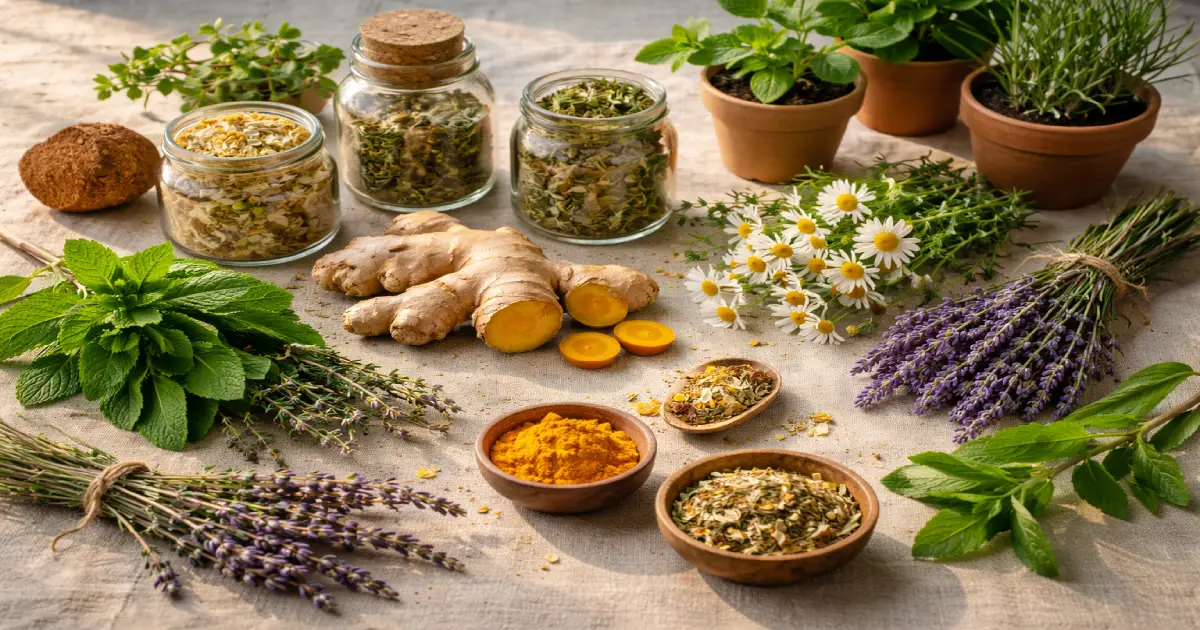
Ginger is one of the most studied plants in the world. Its anti-nausea properties are among the most consistently supported findings in herbal medicine research.
Multiple clinical trials have found ginger effective at reducing nausea caused by pregnancy, chemotherapy, and motion sickness. Its anti-inflammatory compounds, particularly gingerols and shogaols, have been studied extensively for their potential role in reducing inflammation and oxidative stress.
Ginger is used fresh, dried, as a tea, and in supplement form across virtually every traditional medicine system in the world, from Ayurveda in India to traditional Chinese medicine to folk medicine in West Africa and the Caribbean.
It grows well in warm, humid climates in containers or garden beds and is one of the most accessible medicinal plants to grow at home.
Turmeric (Curcuma longa)
Turmeric has become one of the most researched medicinal plants of the past two decades.
Its active compound curcumin has been studied for anti-inflammatory, antioxidant, and potential neuroprotective properties in hundreds of studies. The research is promising but also frequently misrepresented. Curcumin has poor bioavailability on its own, meaning the body absorbs it poorly unless consumed with black pepper, which contains piperine and significantly enhances absorption.
Turmeric has been central to Ayurvedic medicine for over four thousand years and is used in traditional cooking and medicine across South and Southeast Asia.
Chamomile (Matricaria chamomilla)
Chamomile is one of the oldest and most widely used medicinal plants in the world.
Research supports its use as a mild sedative and anxiolytic, with several studies demonstrating meaningful effects on generalized anxiety disorder. It is also well documented as an anti-inflammatory and antispasmodic, with traditional use for digestive complaints having reasonable scientific backing.
Chamomile is widely available as dried flowers for tea and as a supplement. It grows easily in temperate climates and is a practical choice for a medicinal herb garden.
Echinacea (Echinacea purpurea and related species)
Echinacea is one of the most commercially popular herbal supplements in the world, primarily used for immune support and reducing the duration of colds.
The research is mixed. Some studies show modest benefits for reducing cold duration when taken at the onset of symptoms. Others show no significant effect. Part of the complexity is that the genus Echinacea contains several species with different active compound profiles, and many commercial products use different parts of the plant in different preparations.
Echinacea is native to North America and was used extensively by multiple indigenous nations for wound healing and infection before becoming widely adopted in Western herbalism.
Valerian (Valeriana officinalis)
Valerian root has been used as a sleep aid and anxiolytic since ancient Greece and Rome.
Clinical evidence is modest but consistent enough to support its traditional reputation as a mild sedative. Several studies suggest it may improve sleep quality and reduce the time needed to fall asleep, though the mechanism is not fully understood.
It is important to note that valerian can interact with sedative medications and should not be combined with pharmaceutical sleep aids or anti-anxiety medications without medical supervision.
Lavender (Lavandula angustifolia)
Lavender has strong scientific support for its anxiolytic properties, particularly in the form of a standardized oral preparation called Silexan, which has been studied extensively in clinical trials for generalized anxiety disorder.
Aromatherapy use of lavender essential oil also has reasonable evidence supporting mild anxiety reduction and improved sleep quality, though the effects are more modest than the oral preparation.
Lavender is one of the most practical medicinal plants to grow at home. It thrives in well-drained soil in sunny conditions, requires little maintenance once established, and produces abundantly.
Peppermint (Mentha piperita)
Peppermint has one of the strongest evidence bases among medicinal herbs for a specific condition: irritable bowel syndrome.
Multiple meta-analyses have found enteric-coated peppermint oil capsules significantly more effective than placebo at reducing IBS symptoms. The menthol in peppermint acts as a calcium channel blocker in the smooth muscle of the gut, producing an antispasmodic effect.
Topically, peppermint oil has evidence for tension headache relief comparable to some over-the-counter pain medications in certain studies.
Peppermint grows aggressively in almost any condition and is best kept in its own container to prevent it from taking over a garden bed.
You will remain on this website
Traditional Medicine Systems That Center Plant Knowledge
Medicinal plant knowledge did not develop in isolation. It emerged within coherent systems of medicine that integrated plants into broader frameworks of health, diagnosis, and treatment.
Traditional Chinese Medicine is one of the oldest continuously practiced medical systems in the world, with a written history spanning over two thousand years. It uses hundreds of plant species in complex formulas, many of which are now being studied for their individual active compounds.
Ayurveda, originating in the Indian subcontinent, is another ancient system with an extensive plant pharmacopeia. Plants like ashwagandha, holy basil, and neem are central to Ayurvedic practice and have all been the subject of modern research.
Indigenous plant medicine traditions exist on every continent and represent accumulated knowledge developed over thousands of years of careful observation. Many pharmaceutical discoveries have traced directly back to these traditions.
European folk herbalism developed independently and in parallel with Mediterranean traditions, producing a body of plant knowledge that forms much of the basis for modern Western herbalism.
Understanding these traditions provides important context for evaluating medicinal plant claims. A plant that has been used consistently for a specific purpose across multiple unconnected cultures over centuries is not proof of efficacy, but it is a signal worth taking seriously.
How to Find Quality Medicinal Plants and Seeds
The quality of medicinal plants varies enormously depending on the source.
For dried herbs and supplements, look for products that specify the plant species by scientific name, not just the common name. Common names are inconsistent across regions and sometimes refer to completely different species. The scientific name is the only reliable identifier.
Look for products that specify which part of the plant was used. The root, leaf, flower, seed, and bark of the same plant can have completely different active compound profiles. For example, echinacea root and echinacea aerial parts have different compositions and different evidence bases.
Third-party testing certification is one of the most reliable quality indicators for herbal supplements. Organizations like USP, NSF International, and ConsumerLab independently test products for purity, potency, and the absence of contaminants. Products carrying these certifications have been verified to contain what the label states.
Buying Medicinal Herb Seeds Online
For gardeners who want to grow their own medicinal plants from seed, online seed shops offer access to a much wider range of species than any physical store.
Global platforms like Amazon, Etsy, and AliExpress carry medicinal herb seeds from hundreds of sellers. Etsy in particular is an excellent source for rare medicinal herb seeds sold by specialist growers.
Dedicated companies like Strictly Medicinal Seeds specialize exclusively in medicinal, culinary, and aromatic herbs and provide detailed growing and harvesting information alongside each variety.
For buyers in Brazil and Latin America, MercadoLivre and MercadoLibre carry a strong range of local medicinal plant seeds, including many native species used in traditional Brazilian and Latin American plant medicine that are not available internationally.
Where to Buy Medicinal Plants in Person
Health food stores and natural food retailers typically carry a range of dried medicinal herbs, tinctures, and supplements. Quality varies significantly between brands, so applying the same evaluation criteria described above is essential.
Farmers markets in many countries have vendors who grow and sell fresh and dried medicinal herbs directly, often with more variety and better freshness than retail stores.
Botanical gardens and herbal medicine schools sometimes sell seeds, cuttings, and plants directly, particularly for rare or heritage medicinal varieties.
Community seed swaps and gardening groups, both in person and online, are another underutilized source for medicinal plant seeds and cuttings, often at no cost.
Important Safety Considerations
Medicinal plants are not inherently safe because they are natural.
Many of the most toxic substances known to science are produced by plants. The fact that something comes from a plant does not mean it is safe, particularly in concentrated forms or large doses.
Several important safety principles apply across all medicinal plant use.
Drug interactions are a serious concern. Many medicinal plants interact with pharmaceutical medications in clinically significant ways. St. John’s Wort, for example, is one of the most widely used herbal remedies in the world for mild depression, but it interacts with dozens of pharmaceutical drugs including antidepressants, anticoagulants, HIV medications, and oral contraceptives, sometimes with serious consequences. Always inform your healthcare provider about any herbal products you are using.
Correct species identification is essential. Many medicinal plants have toxic lookalikes. Comfrey and foxglove, for example, have been confused with edible plants with fatal results. Always verify the identity of any plant before using it medicinally, ideally using both a plant identification app and a reliable botanical reference.
Dose matters. Traditional medicinal plant use involved specific preparations in specific amounts. Assuming that more is better or that a higher concentration is safer because it is natural is incorrect and potentially dangerous.
Vulnerable populations require extra caution. Pregnant and nursing women, young children, elderly individuals, and people with liver or kidney conditions face different risk profiles for many medicinal plants. Several herbs that are generally safe for healthy adults are contraindicated during pregnancy or for people with specific health conditions.
Frequently Asked Questions
Are medicinal plants a replacement for conventional medicine?
No. Medicinal plants can complement conventional medical care in certain contexts, but they are not a replacement for diagnosis, treatment, or monitoring by a qualified healthcare professional. Anyone managing a health condition should discuss any herbal products they are using or considering with their doctor.
How do I know if a medicinal plant product is genuine quality?
Look for products that list the scientific name of the plant species, specify which part of the plant was used, provide information about the extraction method or preparation, and carry third-party testing certification from organizations like USP, NSF International, or ConsumerLab.
Can I grow medicinal plants at home without any experience?
Yes. Many of the most useful medicinal plants are also among the easiest to grow. Peppermint, chamomile, lavender, and lemon balm all grow well in containers with minimal experience. A sunny windowsill or small balcony is sufficient for most culinary and medicinal herbs.
Is it legal to buy medicinal plant seeds online internationally?
In most countries yes, but regulations vary by species and by destination country. Some plants are regulated due to their potential for misuse or their status as invasive species in certain regions. Always verify import regulations for your specific country before ordering internationally.
How can I identify a medicinal plant I have found growing wild?
Free apps like PlantNet and PictureThis can identify most plants from a single photo with high accuracy. For medicinal use of any wild plant, always verify the identification using multiple sources before handling or consuming it. Consulting a local botanist or herbalist for confirmation is the safest approach for plants you intend to use medicinally.
What is the difference between a herb and a medicinal plant?
All culinary herbs are plants, but not all medicinal plants are culinary herbs. Medicinal plants is a broader category that includes any plant used for its therapeutic properties, whether in food, as a tea, as a supplement, topically, or in other forms. Many plants fall into both categories, basil, ginger, and turmeric for example, which are both food ingredients and subjects of medicinal research.
You will remain on this website
This article is intended for informational and educational purposes only. Nothing in this article constitutes medical advice, diagnosis, or treatment recommendations. The information provided reflects general research findings and does not account for individual health circumstances. Always consult a qualified healthcare professional before using any plant or herbal remedy, particularly if you are pregnant, nursing, taking prescription medications, or managing any health condition. Medicinal plants can interact with pharmaceutical drugs and may cause adverse effects in certain individuals. The publishers of this content accept no responsibility for any health outcomes resulting from the use of information presented here.