Anúncios
Some plants stop you in your tracks.
Not because they are the most common or the easiest to find. But because there is something about them that feels completely unlike anything you have seen before.
A leaf the size of a dinner plate with an impossible pattern. A flower that blooms once a year for a single day. A carnivorous plant that traps insects with a mechanism so precise it seems engineered rather than evolved.
Rare and exotic plants occupy a category of their own in the plant world. They attract collectors, obsessives, and curious beginners alike. And thanks to the global reach of online seed and plant marketplaces, plants that were once only accessible to botanical garden curators are now available to anyone willing to seek them out.
This guide covers the most fascinating rare and exotic plants worth knowing, where to find them, how to care for them, and how to make sure what you are buying is genuine, healthy, and legally sourced.
This article is for informational purposes only. Always verify the legal status of any plant species in your country before purchasing or importing. Some rare and exotic species are protected under international conservation laws.
Every Rare Plant Has a Name. Find It Before You Buy.
- Identify any exotic plant instantly before purchasing to verify you are getting the correct species.
- Many rare plants have lookalike species that are far less valuable or completely different in care requirements.
- Free apps like PlantNet and PictureThis identify plants from a single photo in seconds.
- Knowing the exact scientific name is essential for finding reputable sellers online.
- Misidentified rare plants are one of the most common problems buyers face in the exotic plant market.
- A three-second scan with your phone can save you significant money and disappointment.
What Makes a Plant Rare or Exotic
The terms rare and exotic mean different things depending on context.
A plant is considered rare when it exists in limited numbers in the wild, has a very restricted natural range, or is difficult to propagate and therefore scarce in cultivation.
A plant is considered exotic when it originates from a region far removed from where it is being grown, bringing with it unfamiliar aesthetics, unusual growth habits, or care requirements that differ significantly from common garden plants.
Many plants are both. A tropical orchid species found only in a small cloud forest in Ecuador is rare in terms of wild population and exotic in terms of its appearance and requirements when grown outside its native environment.
The collector appeal of rare and exotic plants comes from precisely this combination. They are visually striking, often challenging to grow well, and connected to remote and fascinating ecosystems around the world.
The Most Sought-After Rare and Exotic Plants
Monstera obliqua
Among the most coveted houseplants in the world, Monstera obliqua is frequently confused with the more common Monstera adansonii but is a genuinely rare species in its own right.
True Monstera obliqua is characterized by leaves that are more hole than leaf, with fenestrations so extensive that the solid leaf tissue becomes the minority. It grows extremely slowly and is notoriously difficult to propagate, which is why genuine specimens command high prices and why misidentified plants are rampant in the market.
If you are buying a plant labeled as Monstera obliqua at a low price, it is almost certainly a Monstera adansonii. Use a plant identification app to verify before purchasing.
Corpse Flower (Amorphophallus titanum)
The titan arum is one of the most famous plants in the world for a single dramatic reason. It produces the largest unbranched inflorescence of any plant on earth, which can reach over three meters in height and emits a powerful smell of rotting flesh when it blooms to attract pollinators.
It blooms unpredictably, sometimes after years of vegetative growth, and each bloom lasts only 24 to 48 hours. Botanical gardens around the world attract thousands of visitors when their specimen blooms. Growing one at home is a long-term commitment measured in years, but the corm is available from specialist sellers for dedicated enthusiasts.
Black Bat Flower (Tacca chantrieri)
The black bat flower is one of the most visually extraordinary plants in existence.
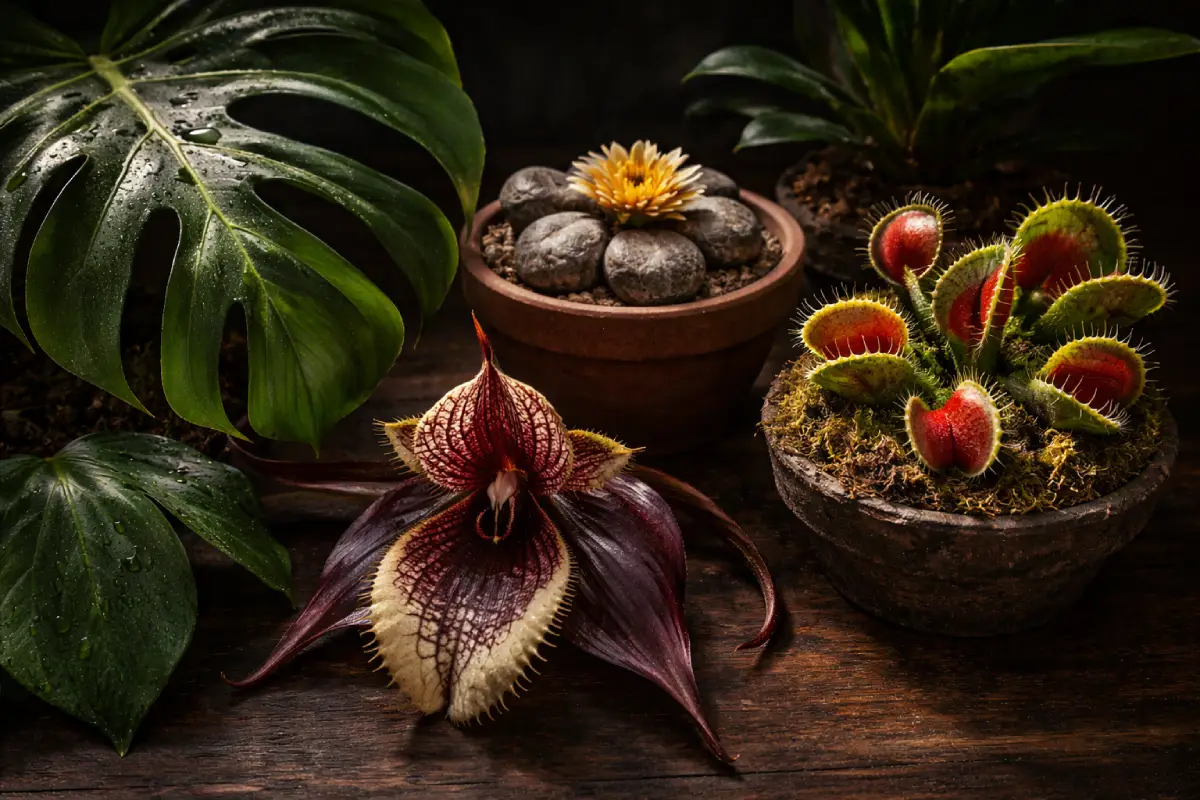
Native to tropical Southeast Asia, it produces deep black flowers with long whisker-like bracts that can reach 70 centimeters in length, surrounded by broad dark wings that give the flower its common name. The overall effect is dramatic, architectural, and completely unlike any common garden plant.
It requires high humidity, filtered light, and warm temperatures, making it challenging but achievable for committed growers in suitable climates or with appropriate indoor conditions.
Welwitschia mirabilis
Welwitschia is one of the most unusual plants on the planet and technically one of the longest-lived organisms in any kingdom.
Native only to the Namib Desert in southern Africa, each plant produces just two leaves throughout its entire life, which can span over a thousand years. Those two leaves grow continuously and become progressively more shredded and twisted by wind and desert conditions, giving mature specimens a dramatic and alien appearance.
It is classified as a living fossil, more closely related to conifers than to flowering plants, and represents a plant lineage that has existed essentially unchanged for over 200 million years. Seeds and young specimens are available from specialist sellers.
Venus Flytrap (Dionaea muscipula)
The Venus flytrap is the most famous carnivorous plant in the world and one of the most studied in terms of its extraordinary trapping mechanism.
Native only to a small region of North and South Carolina in the United States, it is vulnerable in the wild due to habitat loss and illegal poaching. Legally propagated specimens are widely available from reputable sellers and represent one of the most accessible entry points into carnivorous plant collecting.
Growing Venus flytraps correctly requires understanding their specific needs: distilled or rainwater only, poor nutrient-free soil, high light, and a winter dormancy period. They do not need to be fed insects to survive, but they will catch them naturally if grown outdoors.
Rafflesia arnoldii
Rafflesia holds the record for the largest individual flower of any plant in the world, reaching up to one meter in diameter and weighing up to ten kilograms.
It is also one of the most unusual plants biologically. Rafflesia is a holoparasite with no visible leaves, stems, or roots. The entire plant consists of thread-like tissue growing inside the host plant and a single enormous flower that emerges from the host’s surface to bloom for a few days.
It cannot be cultivated outside its native rainforest environment in Southeast Asia and exists only in the wild. It is included here because it represents the outer boundary of what exotic plants can be.
Lithops (Living Stones)
Lithops are succulent plants native to southern Africa that have evolved to mimic the stones and pebbles of their desert environment so convincingly that they are genuinely difficult to distinguish from rocks.
Each plant consists of two fused succulent leaves with a fissure at the top from which flowers and new leaves emerge. They come in an extraordinary range of patterns and colorations, each adapted to camouflage within a specific geological substrate.
They are among the most collectible succulents in the world, require minimal water and care, and are available from specialist succulent and cactus nurseries globally.
Dragon Blood Tree (Dracaena cinnabari)
Native only to the island of Socotra in Yemen, the dragon blood tree is one of the most visually distinctive trees in the world, with a distinctive umbrella-shaped canopy and smooth grey trunk.
Its common name comes from the dark red resin it produces, which has been used in traditional medicine, dyes, and varnishes for centuries. It grows extremely slowly and requires a dry, warm climate, but young specimens are available from specialist sellers for patient collectors.
Where to Find Rare and Exotic Plants and Seeds
The global market for rare and exotic plants has expanded dramatically with the growth of online plant communities and specialist marketplaces.
Etsy is one of the best platforms for finding rare plant seeds, cuttings, and specimens sold directly by specialist growers and collectors around the world. The range of exotic species available from Etsy sellers is genuinely extraordinary and often includes varieties that dedicated plant shops do not carry.
Facebook Groups dedicated to rare plant collecting have become significant marketplaces in their own right. Groups focused on aroids, carnivorous plants, rare succulents, and tropical species often facilitate sales and trades between collectors and provide access to plants that have not yet reached commercial availability.
Specialist online nurseries focused on specific plant families provide the deepest selection and most reliable quality for serious collectors. Nurseries specializing in carnivorous plants, aroids, orchids, or cacti and succulents typically have access to varieties simply not available through general sellers.
AliExpress carries a wide range of exotic plant seeds from Asian sellers, particularly tropical and subtropical species. As with all marketplace purchases, focus on sellers with high order volumes and detailed reviews mentioning germination results.
For buyers in Brazil and Latin America, MercadoLivre connects buyers with local growers who specialize in native tropical species, including many that are genuinely rare outside South America but commonly grown within it.
How to Verify You Are Getting the Real Plant
Misidentification and mislabeling are significant problems in the rare plant market.
The most effective first step is always to verify using a plant identification app. If a seller provides photos of the actual plant you will receive, running those photos through PictureThis or PlantNet takes seconds and confirms whether the species matches the listing.
Search for the plant’s scientific name and compare reference photos from botanical databases and academic sources with what the seller is showing. Kew Gardens, the Missouri Botanical Garden, and the USDA PLANTS database all maintain free, reliable plant image libraries.
For high-value purchases, look for sellers who provide provenance information, nursery propagation documentation, or CITES permits where required for protected species.
Legal Considerations for Rare Plant Collectors
Many rare and exotic plant species are protected under international conservation agreements.
CITES, the Convention on International Trade in Endangered Species, regulates the international trade of thousands of plant species. Some require permits for import and export. Others are banned from international trade entirely.
Before purchasing any rare plant internationally, verify its CITES status and the import regulations of your specific country. Reputable specialist sellers are familiar with these requirements and will provide necessary documentation.
Buying wild-collected specimens of protected species contributes directly to habitat destruction and species decline. Always purchase legally propagated specimens from reputable sources.
Frequently Asked Questions
How do I know if a rare plant I am buying online is genuine?
Use a plant identification app to verify photos provided by the seller. Search the scientific name across botanical databases and compare reference images. For high-value plants, prioritize sellers who provide propagation documentation and have extensive verified reviews from buyers who mention the specific species.
Are rare plants difficult to care for?
Difficulty varies enormously by species. Some rare plants like Lithops living stones and certain rare succulents are actually very low maintenance. Others like black bat flowers and Monstera obliqua require specific humidity, temperature, and light conditions. Always research the specific care requirements of any rare plant before purchasing.
Can I find rare plant seeds on mainstream platforms like Amazon or Etsy?
Yes. Etsy in particular has an exceptional range of rare plant seeds from specialist growers. Amazon carries rare seeds from third-party sellers with varying quality. Always prioritize sellers with large order volumes and reviews specifically mentioning germination success for the species you are buying.
What is the most accessible rare plant for a beginner collector?
Venus flytraps, Lithops, and certain rare succulent species represent excellent entry points. They are legally and widely available, visually extraordinary, and have care requirements that are learnable without significant prior experience.
How do I store rare seeds after I receive them?
Store seeds in a cool, dry, dark environment in airtight containers. For long-term storage, a sealed glass jar with a small silica gel packet kept in the coolest room of your home maintains viability for extended periods. Label everything clearly with the species name and date received.
This article is for informational purposes only. Always verify the legal status of any plant species in your country before purchasing or importing. Many rare plant species are protected under CITES and national conservation laws. Purchase only legally propagated specimens from reputable sources. The publishers of this content accept no responsibility for any legal, financial, or horticultural outcomes resulting from the use of information presented here.